6.4 South Asia: Building the Future Unevenly
Building the Future Unevenly
How does economic growth become human possibility, and why do technology, labor, cities, and resources distribute that possibility so unevenly?

Learning Objectives
After reading this section, you should be able to:
- Explain why economic growth and human development are related but not identical.
- Use Amartya Sen’s capability approach to analyze unequal access to opportunity.
- Distinguish among outsourcing, offshoring, and global capability centers.
- Analyze how services, manufacturing, informal work, and migration connect South Asia to the world economy.
- Explain why artificial intelligence may expand opportunity while narrowing some entry-level paths.
- Evaluate the achievements and environmental costs of the Green Revolution.
- Compare GDP, human development, and Gross National Happiness as measures of progress.
A Shirt, a Line of Code, and a Region in Motion
A shirt hanging in a Minneapolis store may begin as cotton grown in India or Pakistan. The fiber may be spun into thread, woven into cloth, dyed, transported to Bangladesh, and sewn by a worker outside Dhaka. Its inventory may be managed by software written in Hyderabad. Its shipment may pass through Colombo, its payment system may be maintained partly in Bengaluru, and its final price may be set in an office on another continent.
The shirt appears in the store clean, folded, and nearly anonymous. The labor that made it does not.
The world economy is sometimes described as though it exists in a weightless realm of markets, finance, and data. In reality, it occupies fields, factories, cables, ports, apartment towers, roadside workshops, and human bodies. A line of software can cross an ocean almost instantly, but the person who writes it still needs education, electricity, housing, food, and a way through traffic.
South Asia has become one of the central workshops, offices, markets, and laboratories of the modern economy. India is a major center of software, pharmaceuticals, engineering, finance, manufacturing, digital services, and artificial intelligence. Bangladesh is one of the world’s most important exporters of clothing. Pakistan combines textiles, agriculture, manufacturing, and a large overseas workforce. Sri Lanka specializes in services, tourism, and higher-value apparel. Nepal depends heavily on migration and remittances. The Maldives built an economy around tourism scattered across small islands, while Bhutan combines hydropower and controlled tourism with an unusual effort to measure national well-being. Afghanistan remains constrained by conflict, international isolation, and severe restrictions on women’s education and employment.
These countries are not traveling one common road from “traditional” to “modern.” A woman may receive a factory wage through a digital account while living within long-standing gender expectations. A farmer may consult an AI system before irrigating land cultivated by the family for generations. A street vendor may lack a formal business license but accept payment through a nationally regulated digital network.
The old and the new are not separate historical periods. They often occupy the same street.
Growth Changes the Possible
India’s economic rise is one of the great material transformations of the modern era. The country entered independence in 1947 burdened by mass poverty, low literacy, poor health, fragile infrastructure, and the recent memory of famine. Growth was comparatively slow during the first decades after independence. Since the 1990s, reform, investment, urbanization, education, trade, technology, and domestic consumption have supported much faster expansion.
India’s real economy grew by a provisional 7.7 percent in fiscal year 2025–2026. Growth at that speed is unusual for an economy of India’s size, although the national average still hides major differences among states, industries, and households (Ministry of Statistics and Programme Implementation, 2026).
Poverty also fell dramatically. NITI Aayog estimated that about 248 million people moved out of multidimensional poverty between 2013–2014 and 2022–2023. Measures of sanitation, electricity, cooking fuel, schooling, housing, nutrition, and bank access all recorded large gains (NITI Aayog, 2024).
These achievements should not be buried beneath a catalogue of everything still wrong. Families gained longer lives, more schooling, telecommunications, roads, consumer goods, and choices their grandparents scarcely possessed. Girls remained in school longer. Smaller families became common. Migration, film, television, and social media expanded people’s points of comparison.
The change should not be described as an entire culture becoming “advanced.” Cultures do not climb a single staircase from primitive to modern. What changed were resources, expectations, institutions, and practical possibilities.
The transformation remains profoundly uneven. Poverty concentrates in particular states, districts, castes, and rural regions. Education has expanded more quickly than secure professional employment. A young person may earn a degree only to discover that the promised economy does not contain enough places. Economic growth can enlarge the room in which choices are made without giving everyone an equal key.
India has therefore answered one development question spectacularly: can a vast and poor country become much richer within a generation?
It has not fully answered the next one: can that wealth become secure and meaningful opportunity for nearly everyone?
Afghanistan
A broad base signals continued high birth rates and a very young population. Development pressure here centers on schools, health, and future job creation.
Bangladesh
The base is narrower than in the past, showing a major fertility transition. Bangladesh still has a large working-age population, but it is no longer a classic fast-growth case.
Bhutan
Bhutan’s smaller population shows a narrowing base and a more balanced middle. It resembles a society moving away from rapid demographic expansion.
India
India’s pyramid helps explain the scale of the chapter’s economic story: an enormous labor force moving through education, migration, urbanization, and technological change.
Maldives
Because the Maldives is small, the pyramid is more compact, but it still reveals the region’s broader transition toward lower fertility and a larger adult share.
Nepal
Nepal remains youthful, but the lower cohorts are slimmer than older ones. That visual transition fits a country shaped by falling fertility and labor migration.
Pakistan
Pakistan retains one of the region’s clearest youth-heavy pyramids. The age structure implies both tremendous human potential and immense pressure for jobs and services.
Sri Lanka
Sri Lanka’s narrower base and fuller older cohorts mark a noticeably older demographic profile. Compared with Pakistan or Afghanistan, it points toward a different development challenge.
What Is Development For?
The Indian economist Amartya Sen offered a powerful way to think about this problem. Sen argued that development should not be judged only by income, production, or possessions. It should be judged by the real freedoms people have to live lives they value. He called these freedoms capabilities (Sen, 1985, 1999).
A capability is not simply an object or a legal right. It is the practical ability to do or become something.
A bicycle may expand the mobility of a healthy person but be useless to someone unable to ride it. A school may exist nearby, yet a girl may be unable to attend because her family needs her labor, fears for her safety, or refuses permission. A worker may have a legal right to seek employment but lack transportation, childcare, education, social connections, or freedom from discrimination.
Two people can therefore possess the same formal right while having very different capabilities.
Consider a smartphone. It can provide banking, government services, crop prices, job listings, medical information, and artificial intelligence. Yet those possibilities depend on literacy, language, connectivity, money for data, privacy, and control over the device. A household may report owning one phone even when one person decides who may use it.
Sen’s approach does not dismiss economic growth. Poor societies need resources, and families cannot escape hunger through philosophical insight. The capability approach asks what income has been converted into. Can people live longer, avoid preventable disease, attend school, move safely through public space, obtain secure work, participate in politics, and make consequential decisions about their own lives?
The distinction also explains why identical public investments can produce unequal results. A new university may expand opportunity most for students who already attended good schools. A digital government program may be easier to use for people who possess identification, bank accounts, reliable internet access, and confidence dealing with official systems. A road may connect a village to employment while also allowing land speculators to purchase property from households with little bargaining power.
Development is not merely the arrival of a resource. It is the geography of who can use it, on what terms, and toward what end.
Sen’s work helped inspire the human development approach used by the United Nations Development Programme. Human development examines health and education alongside income because the purpose of development is understood as enlarging human possibility rather than simply enlarging an economy (UNDP, 2025).
Beyond the Call Center
India’s rise in global services was initially symbolized by the call center. The arrangement depended on geography: an English-speaking professional workforce, comparatively low wages, telecommunications links, and a time difference that allowed work to continue while North America slept.
Several related terms are often confused. Outsourcing occurs when an organization hires another company to perform work. Offshoring occurs when work moves to another country, whether or not another company performs it. A global capability center is an overseas operation owned by the multinational corporation itself.
India now performs work far beyond routine customer service. Its professionals conduct software engineering, financial analysis, product design, cybersecurity, medical research, legal support, supply-chain planning, and AI development. By fiscal year 2024, India hosted more than 1,700 global capability centers that employed more than 1.9 million people and generated an estimated $64.6 billion in annual revenue (NASSCOM, 2024).
The office may be geographically distant from corporate headquarters while sitting institutionally inside the company.
India has also developed extensive digital public infrastructure. Identity systems, bank accounts, mobile connectivity, and instant payments allow governments and businesses to operate at immense scale. A fruit seller can accept payment through a printed code taped to a cart.
The reach of the digital economy is impressive, but its employment remains selective. Highly productive services can transform national income without directly employing most of the population. Agriculture, construction, retail, transport, domestic work, and small manufacturing still absorb far more labor.
Artificial intelligence intensifies this contrast. AI may translate materials into neglected languages, help a farmer recognize crop disease, assist a physician reading medical images, or give a student individual tutoring. But the farmer still needs an accurate diagnosis and affordable treatment. The student needs enough knowledge to recognize a confident error. The clinic needs nurses, electricity, records, and institutions capable of acting.
The important question is not whether a machine appears intelligent. It is whether people become more capable.
The World Bank estimated in 2025 that about 22 percent of South Asian jobs were highly exposed to artificial intelligence. Within that group, jobs equal to about 15 percent of total employment were highly exposed but also highly complementary with AI, while about 7 percent were highly exposed with low complementarity and therefore faced greater displacement risk. Entry-level and less-experienced professional workers were especially vulnerable (World Bank, 2025).
This may change tasks rather than erase whole occupations. A programmer produces more code; a translator revises machine output; a customer-service worker handles only unusual disputes. Productivity rises, but some first jobs disappear.
That matters because entry-level work is how inexperienced people become experienced. If AI removes the lower rungs of a professional ladder, companies may eventually discover that they have trained too few people to stand at the top.
Factories and the Geography of a Shirt
Bangladesh’s garment industry drew millions of workers into cities, created paid employment for large numbers of women, and tied the country to retailers across Europe, North America, and Asia. During fiscal year 2025–2026, ready-made garments accounted for 80.62 percent of Bangladesh’s merchandise exports, with about $38.7 billion in apparel exports (Bangladesh Garment Manufacturers and Exporters Association, 2026).
A factory wage can expand a woman’s choices while exposing her to long hours, strict supervision, low pay, and unsafe conditions. These are not mutually exclusive stories.
The contradiction became brutally visible in 2013, when the Rana Plaza building collapsed near Dhaka, killing more than 1,100 people, most of them garment workers. International outrage produced inspections, repairs, safety training, and binding agreements among some brands and labor organizations. Conditions improved in many export factories, although subcontracting, union rights, wages, and enforcement remain contested (International Labour Organization, 2023).
The lesson is not that global manufacturing is either wholly beneficial or wholly exploitative. Factory work may provide an alternative to poorly paid agricultural labor while giving workers only a small portion of a shirt’s final value.
Pakistan and Sri Lanka also depend on textile and apparel exports. India manufactures pharmaceuticals, automobiles, electronics, machinery, and many other goods while seeking a larger place in production networks reorganizing across Asia. These chains create opportunity and vulnerability. A distant change in fashion, tariffs, automation, shipping costs, or consumer demand can alter employment in Dhaka, Karachi, Colombo, or Tiruppur.
The factory may be local. The decision to close it may be made elsewhere.
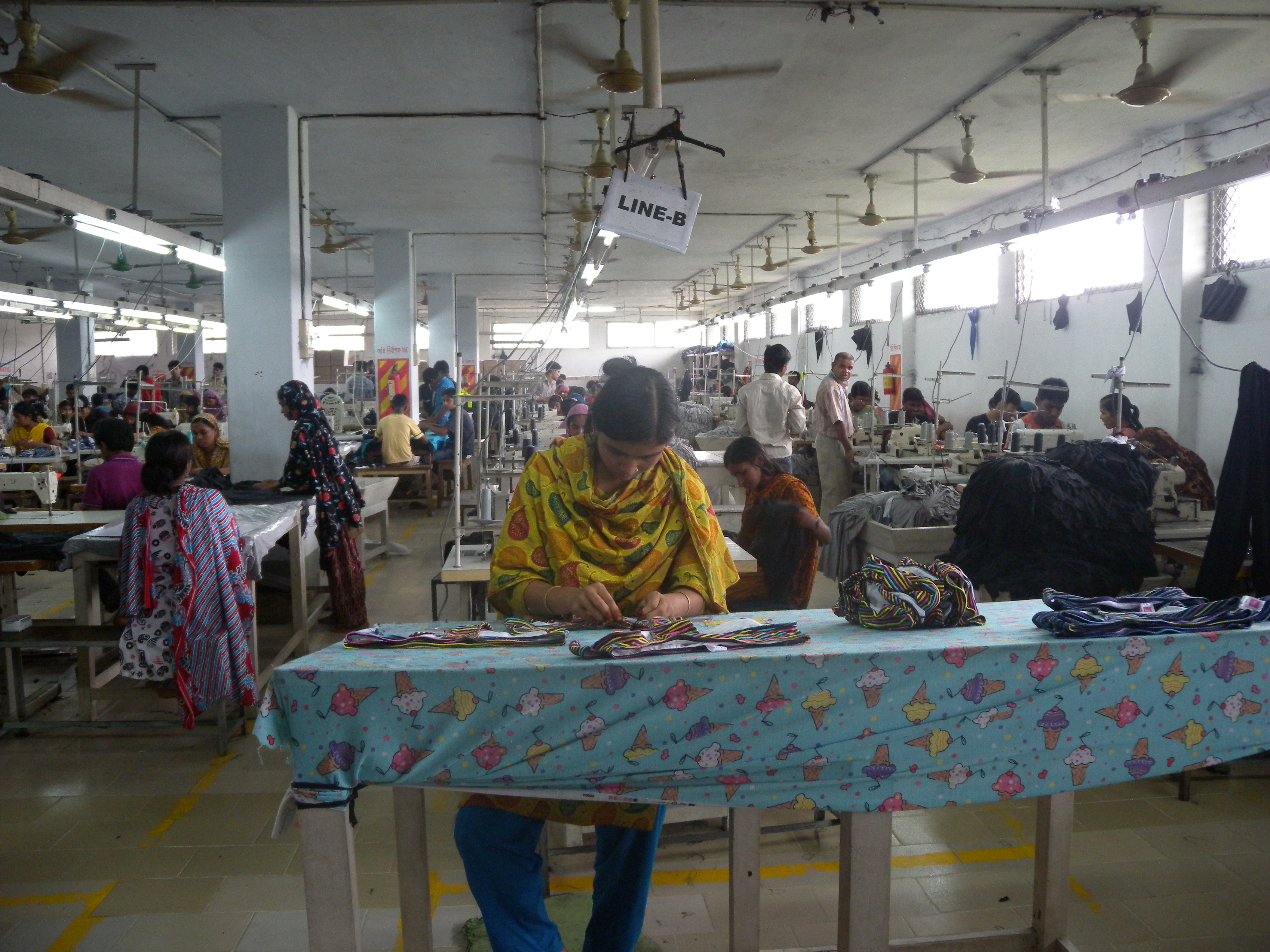
Interactive: Follow the Shirt
Move through five stages. At each one, ask not only what work occurs, but which distant institutions influence it.
The chain begins with land and water
Planting, irrigation, pest control, harvesting, and cleaning fiber.
Seed prices, credit, water policy, textile demand, and the price offered by buyers.
Who carries the risk when rainfall, groundwater, or cotton prices fail?
Teaching model: the five stops simplify a supply chain that in reality branches among many farms, mills, contractors, ports, brands, software systems, and markets.
The Economy Most People Actually Work In
Office towers and export factories are only parts of South Asia’s economy. Much of the region’s work occurs on farms, in homes, markets, vehicles, workshops, construction sites, and streets.
Informal employment generally means work without full legal recognition or protections such as contracts, paid leave, pensions, or unemployment insurance. Informal does not mean imaginary, unproductive, or necessarily illegal. A licensed company may hire an unregistered subcontractor. A formal household may employ a domestic worker without a contract. A shop may purchase from a home-based producer. Formal and informal economies are braided together.

Informality provides flexibility where governments and formal employers do not provide enough jobs. It also moves risk onto workers. Illness can erase income. An injury may bring no compensation. A street vendor may lose goods during an eviction. A construction worker can complete a luxury tower without gaining safe housing.
Caste, gender, education, and location shape who receives which risks. Legal barriers based on caste have been dismantled, reservations have opened public employment and education, and people constantly cross occupational boundaries. Yet discrimination persists through neighborhoods, networks, hiring, credit, and marriage. A person may write software for a global company and still be expected to marry within a narrowly defined caste.
Platform companies have introduced another layer. Ride-hailing, delivery, and online marketplaces can connect workers with customers and provide digital records of transactions. Yet the worker may remain formally independent even when an algorithm determines prices, routes, ratings, and access to future work.
A machine does not need to shout at a worker to exercise control. It can simply stop offering assignments.
Migration extends this economy beyond the regional map. Millions of South Asians work in the Persian Gulf and elsewhere as builders, nurses, drivers, domestic workers, engineers, teachers, merchants, and programmers. Part of their income returns home as remittances.
India received an estimated $129 billion in remittances in 2024, more than any other country, while Pakistan received about $33 billion. The geography looks different when measured against the size of an economy. Remittances are useful to India; in Nepal they accounted for more than one-fourth of GDP in fiscal year 2024 (World Bank, 2024a; World Bank, 2024b).
Remittances can pay for food, schooling, medicine, housing, land, and small businesses. They may reach households more directly than government programs.
But remittances are not money from nowhere. They are wages earned somewhere else.
Migrants may work long hours, incur recruitment debt, surrender passports, or live apart from children for years. Migration expands capability when people choose it among meaningful options. It becomes something different when departure is the only reliable path to a decent income.
Cities Under Construction
South Asia’s cities grow upward, outward, and beyond the boundaries drawn around them. Bengaluru, Dhaka, Karachi, Kathmandu, Mumbai, Delhi, Hyderabad, Chennai, Colombo, and other cities concentrate jobs, universities, hospitals, finance, manufacturing, and culture. They also concentrate expensive housing, congestion, pollution, heat, flooding, and inequality.
A glass office tower rises behind roadside workshops. A metro line passes above homes assembled from brick, sheet metal, concrete, and blue plastic. Apartment buildings appear before the roads and sewers required to serve them. This is not simply chaos. It is economic growth moving faster than housing, infrastructure, and local government.
Informal settlements are not empty spaces outside the real city. Their residents operate repair shops, food businesses, transportation services, recycling systems, workshops, and home industries. They clean offices, construct buildings, deliver packages, sew clothing, and care for children. They make the formal city function.
Families may replace temporary walls with brick, add upper floors, connect electricity, organize water access, and campaign for schools or legal recognition. A household can own a refrigerator, smartphone, and bank account while lacking secure title to the land beneath the house. Rising income does not automatically provide sanitation, clean air, safe streets, or protection from eviction.
A home is not only a structure. It is a position within a web of jobs, schools, customers, relatives, and transit routes. Moving residents into distant apartments may provide stronger walls while severing the relationships that made survival possible.
Climate change adds another inequality. Low-income neighborhoods often occupy floodplains, steep slopes, industrial land, or other places avoided by wealthier households. Their residents absorb more heat, pollution, flooding, travel time, and uncertainty in their bodies. Urban inequality is not simply a difference in possessions. It is a difference in exposure.

The Green Revolution and Its Water Bill
During the 1960s, India and Pakistan faced rapid population growth and serious fears about food security. Governments and scientists introduced high-yielding wheat and rice, expanded irrigation, fertilizer, pesticides, credit, extension services, storage, and grain purchasing. The package became known as the Green Revolution.
The results were remarkable. Production rose sharply in Punjab, Haryana, western Uttar Pradesh, and irrigated parts of Pakistan. India reduced its dependence on imported grain and escaped predictions of recurring famine. Science, public investment, farmers, agricultural workers, and institutions helped feed hundreds of millions.
The achievement depended on a system, not a miraculous seed. Seed performed because water, fertilizer, electricity, roads, research, prices, credit, and government purchasing supported it. Farmers with irrigated land and capital could adopt the package more easily than smallholders in dry regions, so benefits concentrated geographically and socially.
Ecological costs accumulated. Intensive irrigation lowered groundwater. Fertilizer and pesticide polluted soil and water. Poor drainage caused salinization and waterlogging. Price supports encouraged rice and wheat even where they strained water supplies.
The Green Revolution might also be called a tubewell revolution. Pumped groundwater allowed crops to grow when rain was absent and gave farmers control over timing. The same freedom encouraged extraction faster than aquifers could recharge.
Punjab became a symbol of abundance, yet rice spread through an environment not naturally suited to such thirsty production. Subsidized electricity lowered the immediate cost of pumping, while government purchasing made rice profitable. A rational decision for one farmer produced an irrational result for the aquifer shared by everyone.

This is one of geography’s recurring dilemmas. The action that makes sense at one scale may become destructive at another.
The next agricultural transformation will not be one universal package. It will combine heat-, drought-, flood-, and salt-tolerant crops; renewed use of millets and pulses; precise irrigation; soil restoration; better storage; improved weather forecasts; and policies that reward water conservation rather than grain volume. Research suggests that shifting some cereal production toward alternative grains could reduce irrigation demand while improving nutrient production (Davis et al., 2018).
AI can help identify pests or target fertilizer, but it cannot repeal the water cycle.
Knowledge answered the immediate question: how can more grain be grown?
History returned with harder questions: for how long, with how much water, and who bears the cost?
What Counts as Progress?
Gross domestic product measures the market value of final goods and services produced within a country. GDP is indispensable for tracking an economy, but it does not directly measure health, education, unpaid care, political freedom, leisure, ecological security, or inequality.
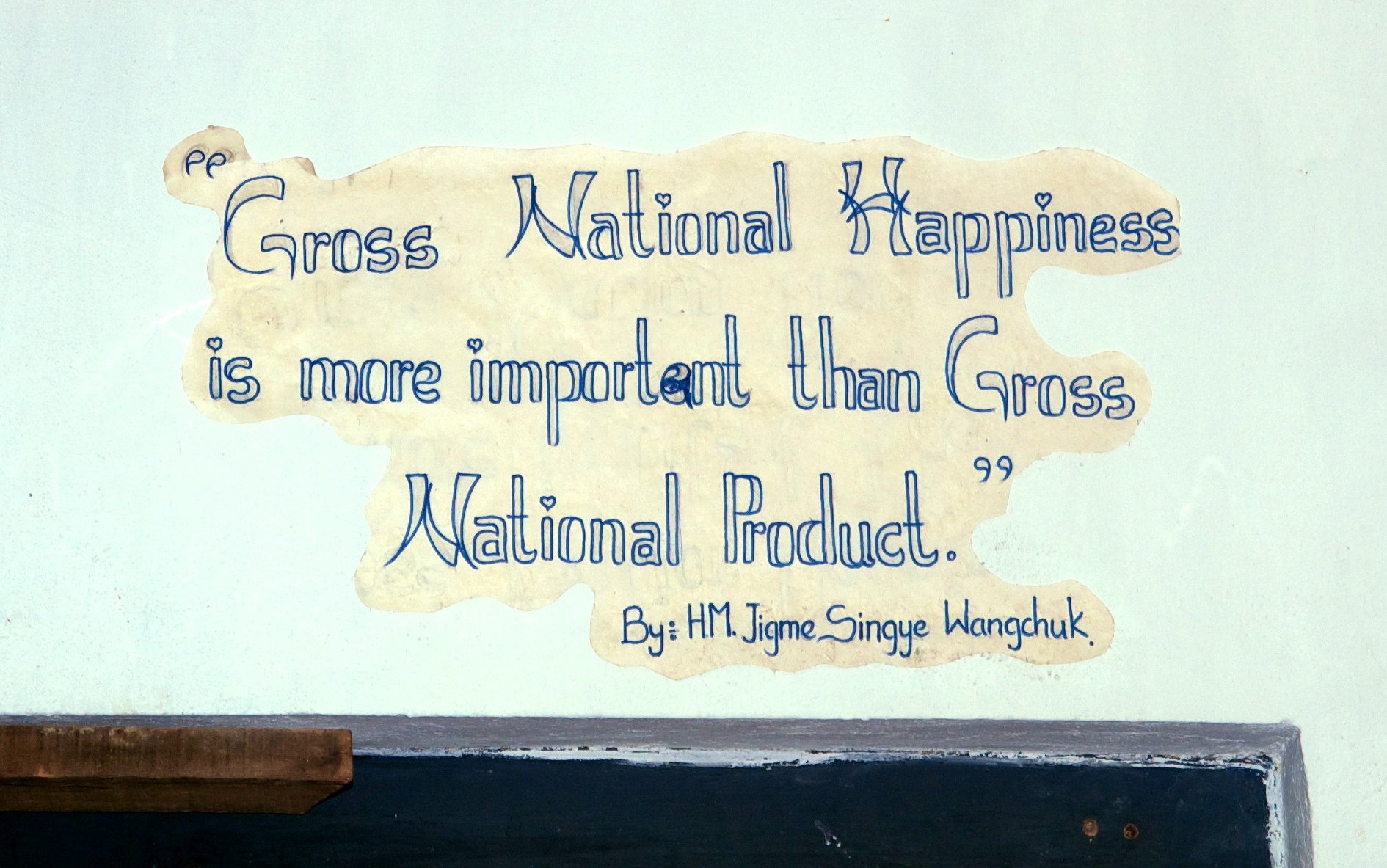
Bhutan made this limitation famous through Gross National Happiness. GNH is not an opinion poll asking whether citizens feel cheerful. Its index considers nine domains: psychological well-being, health, education, time use, cultural resilience, governance, community vitality, ecological resilience, and living standards (Centre for Bhutan and GNH Studies, 2023).
The value of GNH is not that one perfect number can replace GDP. No number can contain a society. Its value is that it forces a government to ask what growth is for.
A dam can increase GDP while displacing a community. A mine can produce exports while degrading water. Longer work hours can raise output while reducing rest and family life. A protected forest may contribute little to measured production while preserving water, biodiversity, culture, and security.
GDP records market activity. It does not decide whether that activity is wise.
GNH has limits of its own. Governments choose the values being measured, citizens may disagree about happiness and tradition, and Bhutan still needs employment and housing for young people. Well-being cannot be preserved by asking an underemployed generation to admire the scenery more deeply.
GDP, human development, and GNH are therefore not rival scoreboards with one winner. They are lenses. Each makes part of reality visible and leaves something outside the frame.
Interactive: What Counts as Progress?
Examine the same hydroelectric dam through four development lenses. Each reveals something important and leaves something outside its frame.
Construction, electricity sales, wages, and investment.
Displacement, unpaid care, cultural loss, and ecological change.
What economic activity appears because the dam was built?
Conceptual model: the same project can look different depending on what a development measure is designed to count. The lenses are analytical frameworks, not four competing numerical scores.
A Future Already Here
South Asia is not waiting outside modernity for permission to enter. The future is already being assembled in a software office in Bengaluru, a garment factory near Dhaka, a pharmaceutical laboratory in Hyderabad, a textile mill in Pakistan, a migrant household in Nepal, and a shop whose owner accepts digital payment beneath a corrugated roof.
This future is brilliant, improvised, productive, and unequal.
Growth has lifted hundreds of millions from severe poverty. Agricultural science prevented hunger on a scale earlier generations feared was inevitable. Digital systems connect households, businesses, and governments across extraordinary distances. Education has expanded a generation’s ambitions.
Yet growth alone cannot tell us whether a worker is safe, whether a woman can choose employment, whether a child is learning, whether a family can remain in its home, or whether a farmer’s well will contain water twenty years from now.
The deepest measure of South Asia’s progress will not be whether its economy becomes larger, its computers faster, or its cities taller. It will be whether people gain the durable power to shape their lives without destroying the foundations on which other lives depend.

That is more difficult than producing growth.
It is also the reason growth matters.
The Main Ideas
- South Asia participates simultaneously in physical and digital global production networks. Software may cross oceans almost instantly, but digital work still depends on workers, electricity, housing, transportation, education, and cities.
- Rapid growth and falling poverty have expanded resources and choices, yet Amartya Sen’s capability approach asks a harder question: what are people genuinely able to do and become with those resources?
- India’s service economy now includes global capability centers, engineering, finance, research, and AI. Artificial intelligence can complement skilled work while also narrowing some entry-level routes through which inexperienced workers become experienced.
- Garment manufacturing demonstrates the ambiguity of development. Factory employment can increase income and autonomy while global buyers, deadlines, subcontracting, and weak bargaining power transfer substantial risk to workers.
- Formal and informal employment are intertwined, and migration extends household economies across borders. Remittances can expand opportunity at home while concealing the separation, debt, and labor conditions through which the money was earned.
- Urbanization concentrates jobs and services but also housing insecurity, congestion, heat, pollution, and flood exposure. A city’s inequalities are written into where people can live and what risks they must absorb.
- The Green Revolution shows that technological success can solve one geographical problem while creating another. Higher yields improved food security, but intensive irrigation and incentives for water-hungry crops helped deplete aquifers.
- GDP, human development, Gross National Happiness, and capabilities illuminate different dimensions of progress. No single measure can decide what a society ought to value.
Key Terms and Definitions
- Capability
- A person’s genuine opportunity to do or become something they have reason to value.
- Digital public infrastructure
- Shared digital systems, such as identification and payments, that support public and private services.
- Formal employment
- Work accompanied by legal recognition and protections such as contracts or social-security benefits.
- Global capability center
- An overseas operation owned by a multinational company that performs internal technical, research, financial, or administrative functions.
- Gross domestic product
- The market value of final goods and services produced within a country during a specified period.
- Gross National Happiness
- Bhutan’s multidimensional approach to well-being through economic, social, cultural, environmental, and psychological indicators.
- Green Revolution
- The expansion of agricultural production through high-yielding crops, irrigation, fertilizer, pesticides, research, credit, and government support.
- Human development
- An approach that evaluates progress through people’s health, knowledge, living conditions, freedoms, and capabilities rather than income alone.
- Informal employment
- Work lacking some legal recognition, regulation, or employment protections.
- Offshoring
- Moving work to another country, whether inside the same company or to an outside contractor.
- Outsourcing
- Hiring an outside organization to perform work previously or potentially done internally.
- Remittance
- Money sent home by a migrant or overseas worker.
Thinking Geographically
- How does the journey of a shirt make the geography of the world economy visible?
- Why can rapid economic growth coexist with insecure employment?
- What is the difference between possessing a resource and having the capability to use it?
- How do outsourcing, offshoring, and global capability centers differ?
- Why might AI improve productivity while narrowing some paths into professional employment?
- How can a garment job be both empowering and exploitative?
- Why are formal and informal economies better understood as braided together?
- Why does remittance dependence look different when measured as a share of GDP rather than as a total amount?
- How can relocating an informal settlement improve housing while reducing capability?
- Why did the Green Revolution depend on much more than improved seeds?
- How can a rational decision by one farmer damage a regional aquifer?
- What does Gross National Happiness reveal that GDP does not, and what can it still miss?
Works Cited & Further Reading
- Bangladesh Garment Manufacturers and Exporters Association. (2026). Export performance.
- Centre for Bhutan and GNH Studies. (2023). Gross National Happiness.
- Davis, K. F., Chiarelli, D. D., Rulli, M. C., Chhatre, A., Richter, B., Singh, D., & DeFries, R. (2018). Alternative cereals can improve water use and nutrient supply in India. Science Advances, 4(7).
- International Labour Organization. (2023). The Rana Plaza disaster ten years on: What has changed?
- International Labour Organization & Institute for Human Development. (2024). India employment report 2024: Youth employment, education and skills.
- Ministry of Statistics and Programme Implementation, Government of India. (2026). Provisional estimates of GDP, fiscal year 2025–2026.
- NASSCOM. (2024). India GCC landscape report: The five-year journey.
- NITI Aayog. (2024). Multidimensional poverty in India since 2005–06.
- Sen, A. (1985). Commodities and capabilities. North-Holland.
- Sen, A. (1999). Development as freedom. Alfred A. Knopf.
- United Nations Development Programme. (2025). Human Development Report 2025: A matter of choice, people and possibilities in the age of AI.
- UN Women. (2026). Aid cuts, employment bans, movement restrictions: The triple threat to Afghan women.
- World Bank. (2024a). In 2024, remittance flows to low- and middle-income countries are expected to reach $685 billion.
- World Bank. (2024b). Nepal development update.
- World Bank. (2025). South Asia Development Update: Jobs, AI, and trade.
- PopulationPyramid.net. (2026). Population pyramids for Afghanistan, Bangladesh, Bhutan, India, Maldives, Nepal, Pakistan, and Sri Lanka. Data from United Nations World Population Prospects 2024 revision, medium variant.
Visual Credits
Open visual and map notes
Photographs link to their Wikimedia Commons source pages and retain the listed creator and license information. The shirt-route and remittance maps are original teaching graphics by Rand-McKay using public-domain Basemap boundary data. The population pyramids are embedded from PopulationPyramid.net under CC BY 3.0 IGO and use the United Nations World Population Prospects 2024 revision. Teaching routes and schematic diagrams simplify complex systems and should not be read as exhaustive maps.


Comments
Post a Comment